
The power bank you can't turn on anymore
Verdict
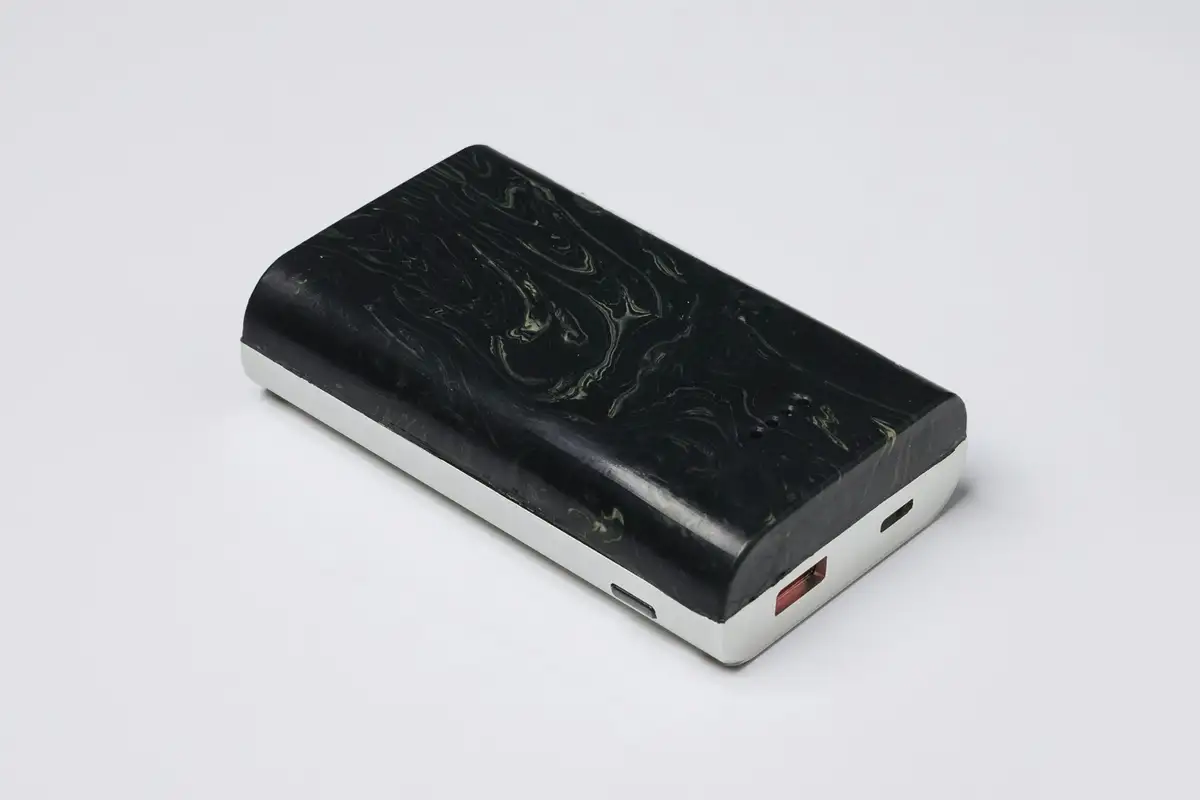
Pick : INIU 140 W power bank, 27000 mAh USB-C, "Airplane Approved" labeling
it stays under the 100 Wh limit and is the only listing in the lot claiming laptop use, but it was bought for a use that's now closing off.
- : your power reserve serves you on the ground, between two outlets, in stations, terminals, and rooms.
Ad. Amazon affiliate links: if you buy after clicking, I earn a commission, at no extra cost to you. En tant que Partenaire Amazon, je réalise un bénéfice sur les achats remplissant les conditions requises. Details
I haven't tested most of the products mentioned here. I analyze from the outside: spec sheets, manuals, standards, published teardowns, and cross-checked public feedback. When I've had the object in hand, I say so. When I can't claim anything, I say that too.
Who it's for
Right for you if
- Your power reserve mostly serves you on the ground, between two outlets, not during a flight
- You recharge a laptop, not just a phone, and need enough wattage
- You pass through stations, terminals, or rooms with scarce or far-off outlets
Not for you if
- You were counting on this reserve for in-flight use, now banned in the cabin by the airlines cited here
- You only recharge your phone; a smaller battery would do
- You rarely need a power reserve away from home
Contents
Three words appear in the listing’s title, ahead of even the model name: allowed on the plane.
It’s true. The seller isn’t lying, and doesn’t need to be dishonest for the phrase to produce the effect it produces. A reader buying a power bank for flights reads those three words as a permission to use it. It isn’t one. It says the object has the right to board.
What it has the right to do once aboard is a different question, one that’s changed recently, and most of what you’ll read on the subject still reasons from how things used to be.
What changed, and where
The Lufthansa Group, which covers Lufthansa, Swiss, Austrian Airlines, Eurowings, Edelweiss Air, and Brussels Airlines, has applied a four-point rule since January 15, 2026. Power banks remain allowed in the cabin. They can no longer be used during the flight. They must stay accessible. The maximum is two power banks per passenger, at 100 Wh each.
Source: the group’s page on this update, checked August 11, 2026.
Two earlier facts put this in context. Charging a power bank off the plane’s USB outlet had already been banned at that same group since May 2025. And Air France had already banned in-flight power bank use before that date, per information found on the airline’s baggage information page, checked August 11, 2026.
I only publish a link for the source whose exact address I can give. For the second, I give the nature of the document and the date, and nothing more. It’s less satisfying than a URL, and more honest than a URL reconstructed from memory.
The origin cited for these decisions is a fire aboard an Airbus A321 in South Korea, in January 2025, attributed to a power bank. I’m relaying that attribution as it circulates in the airlines’ own communications. I haven’t read the investigation report, and I’m not certifying the cause.
What I’m not going to tell you
That this is the rule everywhere.
That would be the natural shortcut, it would be wrong, and it would mislead in both directions: the person counting on a use they’ll be refused, and the person checking their power bank into the hold believing it’s now banned from the cabin. Every airline publishes its own conditions, and they don’t all change on the same day. Seven airlines appear in this piece. There are hundreds of them.
The useful move fits in one sentence: open your airline’s baggage page, the week you fly. A March article doesn’t answer for a November flight.
I’m also not going to suggest tucking it away somewhere out of sight. The rule cited above demands the opposite: the power bank has to stay accessible.
The calculation everyone skips
The regulatory threshold is expressed in watt-hours. Product listings are expressed in milliamp-hours. Almost nobody explains how to get from one to the other, and wrong conversions circulate everywhere.
A milliamp-hour measures an amount of charge, not an amount of energy. It’s a flow rate multiplied by a duration. It says nothing until you know at what voltage that charge is stored.
Energy is obtained by multiplying charge by voltage.
Take the model I settled on. It lists 27000 mAh, or 27 amp-hours. Lithium-ion cells have a nominal voltage of 3.7 volts, and that’s the value used by convention on the markings.
27 times 3.7 gives 99.9.
A little under 100 watt-hours. Just below the threshold, with a tenth of a watt-hour of margin, which is obviously no manufacturing accident.
This is where the trap sits. If you run the same calculation with the USB output’s 5 volts, you get 135 watt-hours, and you conclude the battery is over the cap. That conversion circulates, it panics people three days before departure, and it rests on the wrong voltage. The value that counts is the cell voltage, and the number that holds up in practice is the one printed on the casing.
I haven’t seen that marking, since I don’t have the object.
The counterargument
A big power bank is the most recommended object for flying, and it’s recommended for the reason that’s now falling away.
The sales arguments I found all talk about the flight: lasting through a long-haul, working eight hours on a laptop in the air. At the six airlines cited above, since January, those uses no longer exist. The object boards, and it sits off in the overhead bin, within reach, so it can be pulled out quickly if something happens.
That doesn’t make it useless. It shifts its reason for existing to the ground, and the ground is where I needed it in the first place: the Seville bus-station hall with its one outlet behind a vending machine, the room where the only outlet is behind the bed. A power reserve is for the gap between two outlets, not for thirty-five thousand feet.
Buy it for that, and the reasoning holds. Buy it for the flight, and you’re paying for a heavy object that will spend the flight doing nothing.
An objection I’ll raise against myself, because someone else would otherwise. The model I settled on runs into the same arithmetic: 99.9 Wh at 140 W drains in roughly forty-three minutes. The difference comes down to the amount stored, a third higher under an identical cap. None of these batteries replaces a wall outlet. They’re reserves, and a reserve is judged by what it holds.
None of these five listings publish their watt-hour value in the title checked. For a category of objects whose regulatory constraint is expressed in watt-hours, it’s the one unit missing from every title.
These questions stay open because I haven’t bought any of these five batteries, and the rule that requires me to say so is in what I don’t test.
On the March flight, the person next to me pulled a power bank out of the seat pocket, plugged in their phone, and set it on the tray table. A crew member asked them to unplug it and put it away. The exchange lasted twenty seconds, and I only caught one sentence, said without hostility, with the confidence of someone who’d done their homework: “but it’s allowed on the plane, it says so on the box.” It was. It did say so. I won’t name the airline, since I hadn’t reread its baggage page that day. What sticks with me is that three months earlier, I would have said the exact same sentence, in the exact same tone, just as certain I was right.
INIU 140 W power bank, 27000 mAh USB-C, "Airplane Approved" labeling
This product ships from Amazon's French store: prices in euros, shipped from France, possible import charges outside the EU.
View on Amazon.fr (French store), opens in a new tabMeasurements
| Produit | Capacity listed () | Energy calculated at 3.7 V () | Wattage listed () | Built-in cable () |
|---|---|---|---|---|
| INIU 140 W power bank, 27000 mAh USB-C, "Airplane Approved" labeling | 27000 mAh C | 99.9 Wh (calculated) C | 140 W C | Not mentioned C |
| Power bank, B0DSPVDYQ9 | 20000 mAh C | 74 Wh (calculated) C | 45 W C | Not mentioned C |
| Power bank, B0D8KH4LNB | 20000 mAh C | 74 Wh (calculated) C | 45 W C | Yes C |
| Power bank, B0DCYR5VNR | 20000 mAh C | 74 Wh (calculated) C | 45 W C | Not mentioned C |
| Power bank, B0GGZ447T2 | 20000 mAh C | 74 Wh (calculated) C | 90 W C | Not mentioned C |
Ruled out
| Product ruled out | Reason | Source |
|---|---|---|
| Power bank, B0DSPVDYQ9 | 20 Ah times 3.7 V gives 74 Wh, leaving 26 Wh unused under a 100 Wh per-battery cap, for an object taking up the same pocket. The listing checked makes no claim about laptop use | Manufacturer listing, capacity and wattage as stated, checked August 11, 2026, calculation made from these values |
| Power bank, B0D8KH4LNB | The built-in cable is pushed as a selling point. It's a wear part soldered to the object: the day the connector gives out, the whole power bank becomes a paperweight | Manufacturer listing, built-in cable claimed in the listing, checked August 11, 2026 |
| Power bank, B0DCYR5VNR | The same seller publishes 140 W on another of its models and 45 W on this one. On laptop use, its own lineup settles the question for me | Both listings from the same seller, wattage as stated, checked August 11, 2026 |
| Power bank, B0GGZ447T2 | The smallest reserve of the lot, 74 Wh calculated, paired with the strongest claim. At an advertised 90 W output, 74 divided by 90 gives roughly forty-nine minutes, before even counting conversion losses | Manufacturer listing, capacity and wattage as stated, checked August 11, 2026, calculation made from these values |
What I can't tell you
- Which rule applies on your flight? I don't know. The only one I cite with a source applies to six airlines within one group, as of January 15, 2026.
- Does the watt-hour figure printed on this casing match my calculation? I don't have the object, I haven't read its markings, and it's the marking that counts in front of a gate agent, not my arithmetic.
- Will these rules have shifted again by the time you read this? Three changes in under eighteen months at the airlines cited here. Nothing suggests the series is over.
- Does the advertised 140 W come out of a single port, or is it split across several? The listing doesn't say, and the answer changes what the object is worth for a laptop.
This choice follows the manifesto: no displayed price: the price lives with the seller, with its own date. read the manifesto
Revision log
- Reviewed on 12 August 2026. What changed:Product reference verified: the Amazon link is now live.
Latest articles
The cabin bag everyone recommends, and I skip
The 40x30x20 size is one airline's boarding gauge, not a standard. Twenty-four litres advertised, an EU rule not yet in force, no purchase.

The panel-loading cabin bag that stopped me swearing
An on-paper analysis of a 40 L panel-loading cabin bag, after the missed-bus episode in Chiang Mai.