
A reader heads to Morocco and asks about outlets
Verdict
Pick : TESSAN universal travel adapter, 2 USB-C and 2 USB-A
on this route, the four ports are what matter, the adapter part of it is dead weight.
- : you sleep in rooms with one outlet and charge more than two devices a night.
- : the charger that came with your laptop, it's enough, and you're carrying one less thing
Ad. Amazon affiliate links: if you buy after clicking, I earn a commission, at no extra cost to you. En tant que Partenaire Amazon, je réalise un bénéfice sur les achats remplissant les conditions requises. Details
I haven't tested most of the products mentioned here. I analyze from the outside: spec sheets, manuals, standards, published teardowns, and cross-checked public feedback. When I've had the object in hand, I say so. When I can't claim anything, I say that too.
Who it's for
Right for you if
- You sleep in rooms with only one accessible wall outlet
- You charge more than two devices every night
- You travel to countries with a different plug standard than your own
Not for you if
- The charger that came with your laptop already covers your needs
- You charge one or two devices at most
- You're not crossing into a different country or plug standard on this trip

Contents
A reader writes to me. The message is short and polite, he’s leaving in April, and his question fits in three lines.
I’m going for two weeks, Marrakech then Essaouira. I can’t find a clear answer on the power adapter. There’s one at every price point, some double as chargers, some don’t. Which one would you get?
I’m going to answer, just not that question. It has a one-line answer, that line is going to disappoint him, and the rest of the article starts after it.
The one-line answer
He doesn’t need an adapter at all.
Morocco uses type C and type E plugs, at 220 volts. That’s the French standard, and the Portuguese one too. His plug fits the socket. His charger works. There’s nothing to buy and nothing to pack.
I checked this under the least glamorous conditions possible. Arriving in Tangier at the end of February, the first thing I looked at in the room, before even putting my bag down, was the wall outlet. It was identical to the one in Lisbon. I’d carried a universal adapter around all day, in a side pocket, the way I’ve been carrying it for four years, at the end of a day of four transfers between two countries where I plugged in exactly nothing.
Four years moving an object around without ever checking whether it did anything on my route. I’m not in a position to laugh at my reader’s question.
What I’m not going to do is hand you a table of plug types by country. Hundreds of those exist, all identical, and they’re the reason my reader couldn’t find a clear answer: when fifty pages answer the same question, none of them risks saying the question doesn’t apply. An article that concludes “buy nothing” has nothing to sell at the bottom.
The room, at ten at night
Where the problem actually shows up is three weeks later, in a room in Marrakech, upstairs, with a window looking onto a courtyard.
There’s an outlet. One, thirty centimetres off the floor, behind the head of the bed, which means either moving the bed or sleeping with cables running across the pillow. The table where I work is at the other end of the room, under the window, because that’s where the light is.
On the table, four things that need to be full by the next morning: the laptop, the phone, the headphones, the speaker. The hard drive charges off the laptop, the mouse lasts for months, the paper notebook needs nothing at all.
Four devices, one outlet, one night.
That constraint has nothing to do with the shape of the plug. An old room has one outlet per room because it was wired back when a room held one lamp, and new construction puts four above the desk.
Which shifts the question. The right object isn’t the one that turns one plug shape into another, it’s the one that turns one outlet into four.
The second problem, a mechanical one
There’s a second issue, and I found out about it by living through it two nights running.
This particular socket isn’t firmly fixed to the wall. It moves a few millimetres when you pull on it, and it’s mounted slightly crooked, as often happens in a building rewired over an older one. A light charger holds fine. A heavy block doesn’t: it hangs off its two pins, the weight acts as a lever, the pins slide out two or three millimetres, and the contact turns intermittent.
I found out in the morning, with a half-charged laptop and a phone that hadn’t taken any charge at all. No breakdown, no spark, no drama. A charge that stopped at some point I never saw, because someone closed the room door a bit hard.
And a heavy block delivering power sheds heat, in a recessed socket, with no airflow behind the bed. I’ll note that fact and stop there. I’m neither an electrician nor an engineer, I’m not going to hand out electrical safety advice, and you’ll notice the pages that hand it out for free never sign it with their actual profession.
The practical conclusion, though, I can draw: for the same number of ports, the more compact block wins, and a block that gains ports by gaining bulk gains nothing.
What I’m keeping, and what I don’t know
The one I’m keeping is a universal block with four USB ports, two type C and two type A. It keeps the adapter mechanism, which I have no use for here, and it adds the four ports, which are the entire value of the object. If you never leave the type C and E zone, a multiport charger with no adapter does the same job in a smaller shell.
Now, the uncomfortable part. The listing I checked doesn’t publish this block’s total power. Not the overall figure, not the per-port breakdown.
Further down, I rule out two products over their stated power, and I’m keeping the one whose power isn’t stated at all. That’s an inconsistency, and I’d rather write it in bold than let someone else catch it: I’m keeping it for its port count, which is verifiable, while ignoring the number that would decide whether it can charge a laptop. You’ll find that exact question, unresolved, in the limits section below.
The last reason is the same one that made me rule out two laptops back in February. I’m applying it a second time without hesitation, with one caveat that honesty requires: I’ve just kept a product whose power also isn’t published. The difference is in what I’m asking of it. The four ports are written down, and the four ports are what I’m buying.
Four cells out of fifteen say “not published.” That’s the real information in this table. On a category of object sold by wattage, two listings out of five give no wattage at all, and nobody blinks, because nobody builds the table.
These questions stay open because I don’t buy five blocks to keep one, and the method behind that is laid out in how I choose.
The universal adapter I’ve been carrying for four years finally got used this year, and not by me. A woman I ran into in the riad’s courtyard was heading back to London and had spent ten minutes asking around for “the three-pronged thing.” I had it, at the bottom of the side pocket, under a pouch I hadn’t opened since Seville. She left with it. I waited until I was back in the room to check I wouldn’t need it before summer.
TESSAN universal travel adapter, 2 USB-C and 2 USB-A
This product ships from Amazon's French store: prices in euros, shipped from France, possible import charges outside the EU.
View on Amazon.fr (French store), opens in a new tabMeasurements
| Produit | Rated power () | Ports listed () | Interchangeable heads () |
|---|---|---|---|
| TESSAN universal travel adapter, 2 USB-C and 2 USB-A | Not published in the listing checked C | 2 USB C, 2 USB A C | Not mentioned C |
| Universal GaN travel adapter 75 W, 5 ports | 75 W C | 1 mains, 1 USB A, 3 USB C C | Not mentioned C |
| UPXNBOR ultra-thin universal travel adapter, 15 W | 15 W C | Not detailed in the listing C | Not mentioned C |
| LENCENT universal travel adapter 30 W GaN III, interchangeable plugs | 30 W C | 2 USB A, 3 USB C C | Yes C |
| Anker Nano, universal travel adapter | Not published C | Not published C | Not mentioned C |
Ruled out
| Product ruled out | Reason | Source |
|---|---|---|
| Universal GaN travel adapter 75 W, 5 ports | The listing advertises five ports and a mains output in one body. On a route where the wall outlet already takes a French plug, that mains output is bulk you paid for and will never use, in the heaviest object of the bunch | Manufacturer listing, port count and power stated in the description, checked on 11 August 2026 |
| UPXNBOR ultra-thin universal travel adapter, 15 W | Fifteen watts advertised. The listing never once claims it can charge a laptop, and the laptop is what decides how my next day goes | Manufacturer listing, power stated in the description, checked on 11 August 2026 |
| LENCENT universal travel adapter 30 W GaN III, interchangeable plugs | Thirty watts advertised, five ports advertised, on the same line of the same listing. That figure is a total to be split across whichever ports are in use. The interchangeable plug heads add loose parts to keep track of and lose, for a need this route doesn't have | Manufacturer listing, power, port count and interchangeable heads stated, checked on 11 August 2026 |
| Anker Nano, universal travel adapter | The listing checked publishes neither power nor port count. On a category of object where those two numbers decide everything, a blank listing has already answered | Product listing, absence of data confirmed, checked on 11 August 2026 |
What I can't tell you
- How much total power does the block I'm keeping actually deliver? The listing checked doesn't publish it, so I'm recommending an object on a partial criterion. That's the weak point of this piece, and it's better here, in plain sight, than buried in a footnote.
- Does each of four devices plugged in at once get what the listing promises? None of these five listings publish a per-port breakdown, which makes comparing them impossible.
- Does the outlet in that Marrakech room look like yours? No, and I draw nothing general from it. One room, one building, two nights of observation, in a country where I'm spending a few weeks.
This choice follows the manifesto: no displayed price: the price lives with the seller, with its own date. read the manifesto
Revision log
- Reviewed on 12 August 2026. What changed:Product reference verified: the Amazon link is now live.
Latest articles
The current isn't a constant
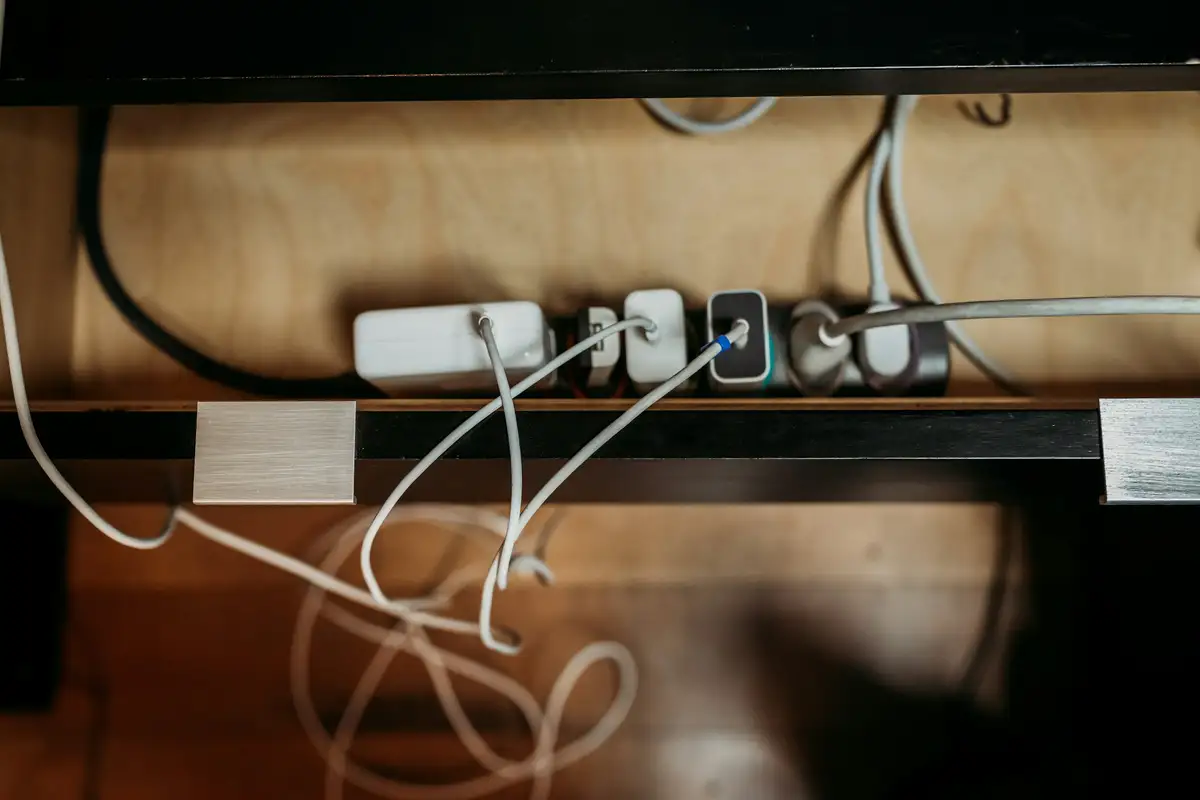
A storm killed my power strip in May, and everything plugged in behind it survived. Two months to understand what that doesn't prove.
Six chargers, one day, five eliminated
A day in Seoul replaces the usual comparison table. Each hour disqualifies a candidate for a different reason. Four models, two families, one kept.

The Chiang Mai storm that ate my power strip
A power surge during a storm, a power strip that died silently, and everything plugged into it still working. No explanation.