
Six chargers, one day, five eliminated
Verdict
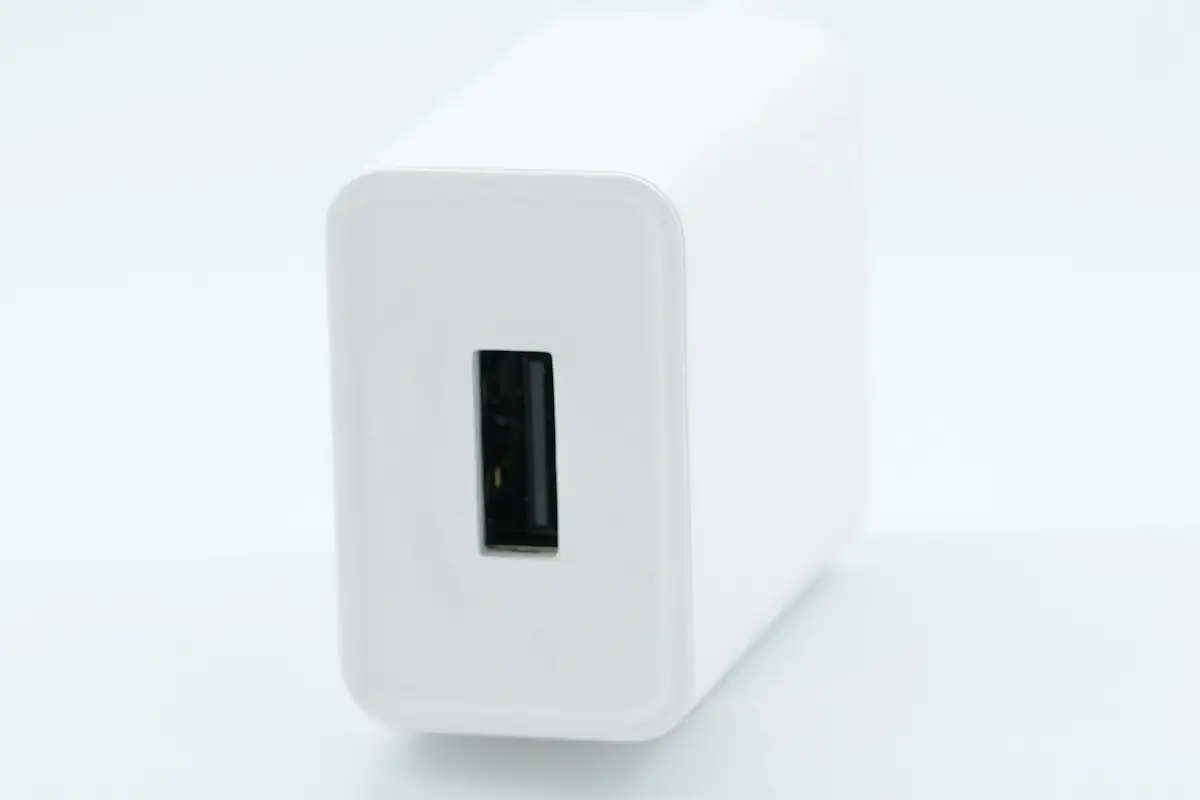
Pick : UGREEN Nexode 65 W, 3-port GaN USB-C charger
three ports, rated power that covers a laptop, and a listing that doesn't promise anything more.
- : you're filling two or three devices in the evening, off a single outlet, in one room.
- : your laptop's original charger, it works, and you've already paid for it
Ad. Amazon affiliate links: if you buy after clicking, I earn a commission, at no extra cost to you. En tant que Partenaire Amazon, je réalise un bénéfice sur les achats remplissant les conditions requises. Details
I haven't tested most of the products mentioned here. I analyze from the outside: spec sheets, manuals, standards, published teardowns, and cross-checked public feedback. When I've had the object in hand, I say so. When I can't claim anything, I say that too.
Who it's for
Right for you if
- You charge two or three devices every night off a single outlet
- You want rated power that actually covers a laptop, not just a phone
- You travel light and want one block instead of several chargers
Not for you if
- Your laptop's original charger already works and you don't want to pay for a duplicate
- You only ever charge one device at a time
- You already have a multiport block that works for you
Contents
I started this article the way everyone does: with a spreadsheet. A power column, a ports column, a weight column, a certifications column.
I lasted twenty minutes. What stopped me was the next column, the one I couldn’t fill in, called “when does this actually matter.” The first four columns all came from the same place: the seller’s listing. Every row in a grid is a claim made by someone with a product to move, and I was dutifully lining them all up.
I took a day in Seoul instead and used it as my grid. Places don’t sell anything.
One note before I start, because the title promises six candidates and I don’t have six listings. Four exist as specific, open, checked models, checked on 11 August 2026. The other two are entire families, ruled out upstream, without my looking at a single unit. They count among my six, and they have no product source, which is exactly why I’m telling you now instead of in a footnote.
7:10am, the room
One wall outlet. Just one, behind the headboard, thirty centimetres off the floor, reachable by kneeling on the mattress.
Two devices to fill before heading out, and eighty minutes to do it.
First elimination, and it’s a whole family: single-port chargers. With one outlet and a short window, every missing port is a device waiting its turn. My own laptop’s original charger belongs to this family. It’s in my bag, it works fine, and it’s the only object in this entire article I can speak to firsthand.
This elimination targets no specific model and rests on no listing. It rests on one outlet and one departure time.
8:40am, the café
A long room, tables against the wall, a floor outlet every three metres. Two customers already have something plugged in.
Second elimination: the four-port model sold with a two-metre cable. The listing advertises that cable as an included feature, a selling point (listing checked on 11 August 2026). In a café with floor outlets, two metres of cable between the outlet and the table is a tripwire across a walkway.
Length isn’t a flaw in itself, it is one here, and “here” is exactly what no spreadsheet contains. I’ve already knocked a cup off a table this way once.
11am, a shared workspace
Large table, a power strip in the middle, six blocks already plugged in and fighting for room.
Third elimination: the hundred-watt, three-port model. Its listing states the composition: two connector types, one of them the older rectangular kind (listing checked on 11 August 2026). A third of the ports taken up by a connector none of my devices use anymore, except one old speaker cable.
The listing also advertises a hundred watts total, without publishing what each port delivers with two devices plugged in together. That breakdown is the only figure I actually care about, and none of the four listings checked publish it.
I’m not claiming to know what this charger really delivers. I plugged in nothing, measured nothing. I’m noting an absence on a sales page, which is a far more modest fact.
3pm, the cable pouch
Nothing special about this hour, except that I’m repacking my bag before heading out, and the cable pouch is open on the bed.
Fourth elimination: the four-port gallium-nitride model. Its listing lines up four technical badges and a total power figure (checked on 11 August 2026). Four ports are only worth anything with four cables to go with them, and those four cables live in a pouch I carry every day.
The charger weighs what it weighs. It’s the cables that add bulk, and a charger gets chosen together with its pouch, or it doesn’t get chosen at all.
7pm, back in the room
The moment of the day when everything charges at once, and the only one where I genuinely need several ports.
Fifth elimination, and it’s the second family: blocks that combine a wall plug with a built-in battery. The idea is appealing on paper. It puts a lithium cell inside an object that stays plugged in all night, and turns my charger into a power bank, with all the rules that come with it. The Lufthansa Group, which I wrote about this spring, has banned the use of power banks in flight since 15 January 2026. An object that changes regulatory category just to save me one outlet doesn’t tempt me.
Again, no listing behind this refusal. A family, a line of reasoning, and I’d rather write it that way.
10pm, what’s left
One candidate. Three ports, 65 watts advertised, gallium nitride.
It wins by elimination, and I’m not going to dress that up as enthusiasm. None of the five reasons for rejection applies to it: three ports rather than one, no long cable forced into the box, no older connector advertised in its listing, only three cables to carry, no battery inside.
Two things I don’t know. Its listing doesn’t advertise an older connector, which doesn’t guarantee there isn’t one. And its power split across the three ports isn’t published, exactly like the other three: that flaw is common to all four, which makes it useless as a reason for elimination.
Why a day instead of a spreadsheet
This is the one article in this logbook where the method interests me more than the object.
A spreadsheet compares products against each other, with rows supplied by sellers. A day compares products against places, and places don’t sell anything. The outlet behind the headboard, the café’s floor outlet, the crowded power strip at the shared workspace, the pouch open on the bed: none of these four things appears in a product listing, and all four ruled someone out.
The limit of this method is obvious. My day isn’t yours: if you work eight hours at the same desk with four outlets under the table, my fourth elimination is worthless for you, and the four-port model probably becomes the right call.
Two eliminations are missing from the table above, single-port chargers and battery-integrated blocks. They’re not there because they target no specific model, and a reason with no source has no business in that right-hand column. They still count among my six.
No M anywhere in this table, and there won’t be one. Measuring delivered power needs an instrument between the outlet and the device, I don’t have one, and copying a listing’s number while presenting it as a personal reading is exactly what this site exists to call out.
These three questions stay open because I don’t buy four chargers to keep one, and the method behind that is laid out in how I choose.
That same evening, I emptied the cable pouch onto the bed and counted. Five cables for four devices. The fifth goes to a speaker I’ve replaced twice since, with a connector nothing else I own still uses, and I’ve been carrying it from country to country for probably two years now.
The number of ports I need isn’t set by the number of my devices. It’s set by the number of cables I’m willing to carry, and I’ve just discovered I had no control over that number at all.
UGREEN Nexode 65 W, 3-port GaN USB-C charger
This product ships from Amazon's French store: prices in euros, shipped from France, possible import charges outside the EU.
View on Amazon.fr (French store), opens in a new tabMeasurements
| Produit | Total rated power () | Ports listed () | Per-port breakdown published () | What I actually know () |
|---|---|---|---|---|
| UGREEN Nexode 65 W, 3-port GaN USB-C charger | 65 W C | 3 C | Not published in the listing checked C | Never plugged in by me C |
| 65 W USB-C charger, 4 GaN PD and PPS ports, 2 m cable included | 65 W C | 4 C | Not published C | Never plugged in by me C |
| 100 W USB-C charger, 3 ports, GaN | 100 W C | 3, one of the older type C | Not published C | Never plugged in by me C |
| ViSSKO 65 W USB-C charger, 4 PD ports, GaN II, PPS | 65 W C | 4 C | Not published C | Never plugged in by me C |
Ruled out
| Product ruled out | Reason | Source |
|---|---|---|
| 65 W USB-C charger, 4 GaN PD and PPS ports, 2 m cable included | The long cable is advertised as an included feature. On a floor outlet in a public place, two metres between the outlet and the table cross a walkway | Product listing, cable and length stated in the description, checked on 11 August 2026 |
| 100 W USB-C charger, 3 ports, GaN | The listing advertises one of the three ports as the older rectangular type. A third of the ports taken up by a connector I no longer use | Product listing, port composition stated in the description, checked on 11 August 2026 |
| ViSSKO 65 W USB-C charger, 4 PD ports, GaN II, PPS | Four ports require four cables to be worth anything, and the listing lines up four badges without publishing how power is split between ports | Product listing, checked on 11 August 2026, absence of a power breakdown confirmed |
What I can't tell you
- What does each of these chargers actually deliver with a laptop and a phone plugged in together? None of the four listings publish that breakdown, and it's the question that decides the purchase.
- Does the one I kept run hot in an old, recessed wall socket? I have neither the charger nor a thermometer, and a warm-to-the-touch impression is worthless as a measurement.
- Do four ports ever actually get used? I've never had four devices to fill at once, but I've never counted either, and an elimination built on an unverified habit is shaky.
This choice follows the manifesto: no displayed price: the price lives with the seller, with its own date. read the manifesto
Revision log
- Reviewed on 12 August 2026. What changed:Product reference verified: the Amazon link is now live.
Latest articles

A reader heads to Morocco and asks about outlets
A reader asks which adapter to bring to Marrakech. He doesn't need one. The real problem shows up once the room has only one outlet.
The current isn't a constant
A storm killed my power strip in May, and everything plugged in behind it survived. Two months to understand what that doesn't prove.

The Chiang Mai storm that ate my power strip
A power surge during a storm, a power strip that died silently, and everything plugged into it still working. No explanation.