
He took the case for my headphones. I was wearing the headphones.
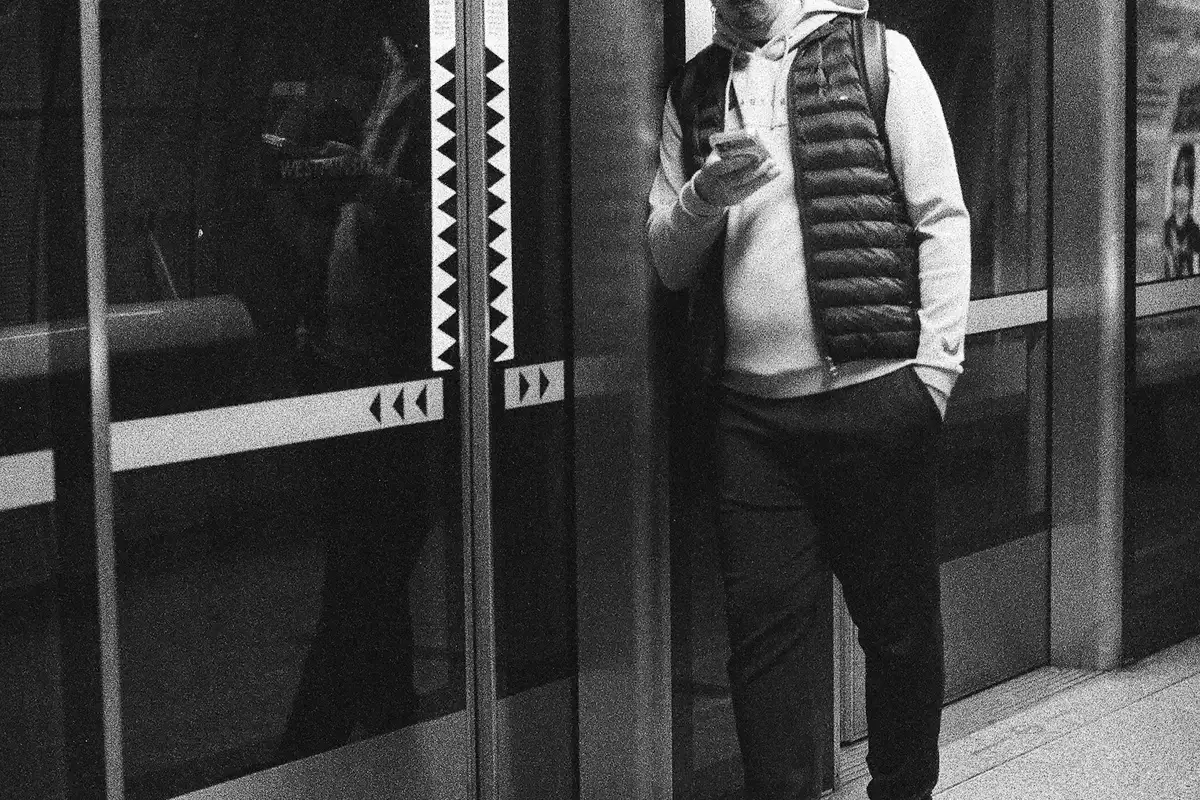
My bag was in the overhead rack, right above me. Not two rows down, not at the other end of the carriage. Above me. I could have touched it by raising my arm.
Someone opened it during the ride, reached in, took two things, and left it there. I saw nothing, because I was looking at a screen. I heard nothing, and that’s the detail I still find funny seven months later: I had noise cancelling turned all the way up, on headphones that cost the price of a long-haul flight, for the express purpose of hearing nothing.
The tool that made the theft possible and the object that got stolen are almost the same object.
What was missing
I noticed in Lisbon, taking the bag down. The zipper on the main compartment was open about twenty centimetres. Not torn, not forced. Open, the way you open a bag that’s your own.
The computer was missing. A 15 inch LG Gram, in its padded sleeve. The one that weighs barely more than a thick magazine, lasts the day without a charger, and had the worst keyboard I’ve ever used. A soft, mushy key travel with no feedback, on which I typed twice as many mistakes as on anything else. I’d been complaining about it for two years.
And the case for my headphones was missing.
The case. Not the headphones. A Sony WH-1000XM4 packs into a rigid case shaped like a flattened pebble, which takes up an absurd amount of room in a bag, and which I complained about almost as often as the keyboard. That case was empty. All that was left inside was a jack cable and a USB cable.
The headphones, meanwhile, were on my head. They’d been there since Porto. They were still there when I opened the bag in Lisbon.
What he left behind
The external hard drive, in its fabric pouch, at the bottom.
The security key, the little plastic thing that unlocks my accounts, in the front pocket. The one that opens by pulling a tab, effortlessly, in a second.
The mouse. Two chargers. An adapter. A tangle of cables held together with an elastic band.
Add it up. What he left in that bag is worth more on resale than the empty case he took. And the security key, taken along with the computer, would have turned a gear theft into a problem of an entirely different order.
He didn’t take it. He didn’t look.
Four seconds of sorting
Here’s what this episode taught me, and it’s the only thing I took from it.
A guy who reaches into a bag on a train doesn’t take inventory. He has a few seconds, he’s standing in an aisle, and he sorts blind with one simple rule: whatever has the shape of an expensive object is an expensive object.
A rectangular padded sleeve is a computer. He took it, and he was right.
A hand sized, molded, rigid case with a zipper running all the way around is a fragile, expensive object. He took it, he was wrong, and he never opened it to check. It weighed four hundred grams less than headphones, and he didn’t even notice the difference, because he wasn’t trying to.
A hard drive in a soft fabric pouch looks like a toiletry bag. An authentication token looks like a plastic keyring. A mouse looks like a mouse, and nobody steals a mouse.
The sorting happens by appearance, not by content. I’d always believed the opposite, without ever questioning it, because I’d never had to.
What would have helped
Not a padlock. A padlocked zipper on a canvas bag, on a train, signals a bag that has something worth taking.
Not a tracker either. All it tells you is that your computer is now in a neighborhood of Lisbon where you don’t want to go knocking on doors.
What would have helped fits in one sentence I wouldn’t have written before January: stop packing my things in containers that advertise what’s inside them. A padded laptop sleeve is a label. A molded headphone case is a label. They’re sold as protection, and they also do signaling, for free, in both directions.
Since then, the computer travels in a plain fabric pouch, and the headphones no longer have a case at all. They hang off the bag by their headband, in full view of everyone, which is exactly the opposite of what any travel security guide recommends. Nobody has touched them in six months.
I should be clear that I’m not drawing any general rule from this. One case, one line, one thief, seven months of observation. It’s an anecdote that made me change a habit, not a method.
This logbook doesn’t try most of what it talks about, and that’s stated plainly in what I don’t try. The objects mentioned here are an exception: they were mine, and I used them every day. That lets me say what they did for me, nothing more, not that they were good, not that they beat whatever’s in your bag.
I’d been complaining about that case for two years. Too big, too rigid, badly designed for something you wear on your head and never actually put away. I spent two years telling anyone who’d listen that I’d get rid of it someday. Someone took care of that for me, somewhere over the three hundred kilometres between Porto and Lisbon, and I’ve never replaced it.
What I can't tell you
- Did this guy open other bags in the same carriage? No one else reported anything on arrival, but no one else checked in front of me either.
- Would a bag locked with a padlock have been skipped in favor of the next one, or targeted first? Both theories get thrown around, and neither is backed by anything serious.
- Would I have heard anything without noise cancelling? A canvas bag's zipper, a meter away, on a moving train. I'm not sure, and it half suits me not to know.
This choice follows the manifesto: no video: the verdict is meant to be read, not watched. read the manifesto
Latest articles

The Hanoi-Đà Nẵng night train sets its own rules
Four berths, a light that never turns off, and a bag you have to watch while asleep. Three constraints, three answers of very different bulk.

Two countries before breakfast
Faro, Seville, Tarifa, Tangier. Twelve hours, four connections, zero minutes of work, and one working power outlet.
Someone asked if I work on night trains
The full answer, including the nights that produced nothing. A train gives you continuous time, and continuous time isn't enough on its own.