
Six months after the theft, what I haven't replaced

Contents
A reader wrote to me in June. Three sentences, and the last one is what produced this piece.
You wrote a piece about the laptop you replaced in four days. Is there anything you haven’t replaced?
The short answer is one object. A machine, bought in February in Lisbon, under time pressure. Since then, nothing. Six months on the road, three continents, and not a single replacement.
I hadn’t noticed until I made the list on the table of a room in Batumi, with the paper notebook and the January inventory in front of me.
The headphone case
It went missing in the luggage rack of a train between Porto and Lisbon, empty, with two cables inside it, while the headphones were on my head. The full story is in the first piece of this logbook, and I’m not going to retell it here.
What the absence changed, though, can be measured.
The headphones have hung off the bag by their headband for six months. They picked up a scratch, on the right earcup, against the back of a chair in a Taipei train station. It’s visible, it isn’t going away, and it doesn’t bother me much.
The bag itself, though, has changed shape. The rigid case took up a fixed volume and held the bag open from the inside, something I never noticed until it disappeared. Without it, the fabric sags, and everything small sinks to the bottom. The cable pouch is three times more annoying to find than it was in December. That’s a real cost, one that has nothing to do with protecting the headphones, and nobody could have predicted it for me.
I’d been complaining about that case for two years. Two years of complaining never produced anything. Four seconds in a train corridor did.
The headphone cable
It was in the case. It left with it.
I missed it once, in April, at eleven thousand metres, on a thirteen-hour flight whose seat screen offered a wired headphone jack and nothing else. I had wireless headphones the plane refused to recognise, wired earbuds with the wrong tip, and twelve hours ahead of me.
An absence that costs something specific, exactly once in six months, on a date I can name. That’s the kind of accounting I prefer over speeches about how much a bag weighs.
The padded sleeve
The machine I replaced in February never got a dedicated sleeve. It travels in some generic fabric pouch, no logo, no padding, that doesn’t look like anything in particular.
The back left corner of the lid has carried a mark since May. It’s from a van ride, on a road where I’d set the bag against a wooden crate. A padded sleeve would have prevented it, and I know it.
I still haven’t bought one, because I keep thinking that a case advertising what’s inside it is a label, and that was the one useful thing I took away from January. That conviction cost me a mark on a laptop lid. It hasn’t earned me anything I can prove, since you can’t measure a theft that didn’t happen.
The padlock
That one wasn’t stolen. It’s in the drawer of a room in Lisbon, where I left it in February after spending forty minutes recovering its combination by exhausting all thousand possibilities.
Its absence hasn’t changed anything I can measure. What it removed is a daily decision: do I lock it, do I not, is it worth it for three hours in a luggage locker. The decision no longer comes up. I’m not saying that’s better. I’m saying it’s one less thing to weigh every day, and I would never have gotten there by deciding anything.
The orphaned charger
It’s the only object on this list I removed myself, and it deserves telling because it half-contradicts everything above.
The charger for the stolen machine was still in the bag the day of the theft. It’s listed in the January inventory, catalogued as perfectly useless. I carried it for nine weeks. Lisbon, Faro, Seville, Tarifa, Tangier, Marrakech. An object in perfect working order, with no machine left to power, carried two thousand kilometres because throwing away a working device apparently takes an effort I can’t afford.
It ended up in a room’s bin in Marrakech, in March. Nine weeks and six cities to remove from a bag an object I knew, from day one, was no longer any use at all.
Did the habit hold?
That’s the question I’d left open in January, and six months is roughly the point at which you can answer it without kidding yourself.
The rule that costs nothing held with no effort at all. None of my containers advertise what’s inside anymore, and I never had to think about it, because keeping that rule just means not buying anything.
The rule that costs something has eroded. The backup drive was never supposed to travel in the same bag as the machine it backs up. It’s gone back in three times since May, on days when carrying two bags to work from a café felt like punishment. The security key, on the other hand, has stayed in the jacket, because it only costs me three seconds a day.
It’s not a question of discipline, it’s a question of price. A free habit holds. A habit you pay for every morning wears down, and it wears down all the faster the longer nothing bad happens in the meantime.
What six months of absence lets me say
A reader had asked me in January what I was entitled to claim about objects I haven’t tried. The list above asks the question from the other end, and the answer is the same, which surprised me while writing it.
Six months without a rigid case prove nothing about rigid cases in general. They prove that, on this particular route, with this headphone and this bag, I did without one at the price of a scratch and a bag that sags. Someone who flies four times a month with the same headphones in a checked bag has a different equation, and I have no way to solve it for them.
Absence isn’t proof. It has exactly the same status as ownership: it tells one case, one use, one duration, and nothing beyond that. I can no more recommend doing without an object than I can recommend an object I’ve never held, and it’s the same limit either way. What I refuse to do on this site is written in what I refuse to do.
The only thing I’ll claim after these six months is about me, not about the gear. I have never removed anything from this bag by decision. I removed things because a stranger took care of it in four seconds, because a forgotten combination made a padlock unbearable, because a cable went sticky in the sun. Seven hundred days of complaining about a case never produced what a train corridor produced without me. I don’t have a method for triggering the event, and I’m wary of anyone selling one.
I wrote to the guesthouse in Lisbon in June, to ask if the padlock was still in the drawer. The answer came back the next day, with a photo: it’s there, in the top drawer, next to a charger and a man’s sock. They offered to send it to me, free of charge, the host knows the site. I haven’t replied, and it’s now been three weeks.
What I can't tell you
- Would I buy a rigid case again if I switched headphones tomorrow? Probably, straight out of the box, without thinking twice, and this whole list would have served no purpose.
- How many objects have I bought again over six months without noticing, below the threshold where I even ask myself the question? The cable pouch has picked up three items I have no memory of buying.
- Are six months enough to say an absence has become permanent? A long-term stay, a winter, or a dropped laptop, and half this list could be bought back in a week.
This choice follows the manifesto: no video: the verdict is meant to be read, not watched. read the manifesto
Latest articles

No signal, no cash, three kilometres out
The phone shows four bars and won't send anything through. The card is valid and the terminal refuses it. Nothing is broken, and I end up walking.
The current isn't a constant
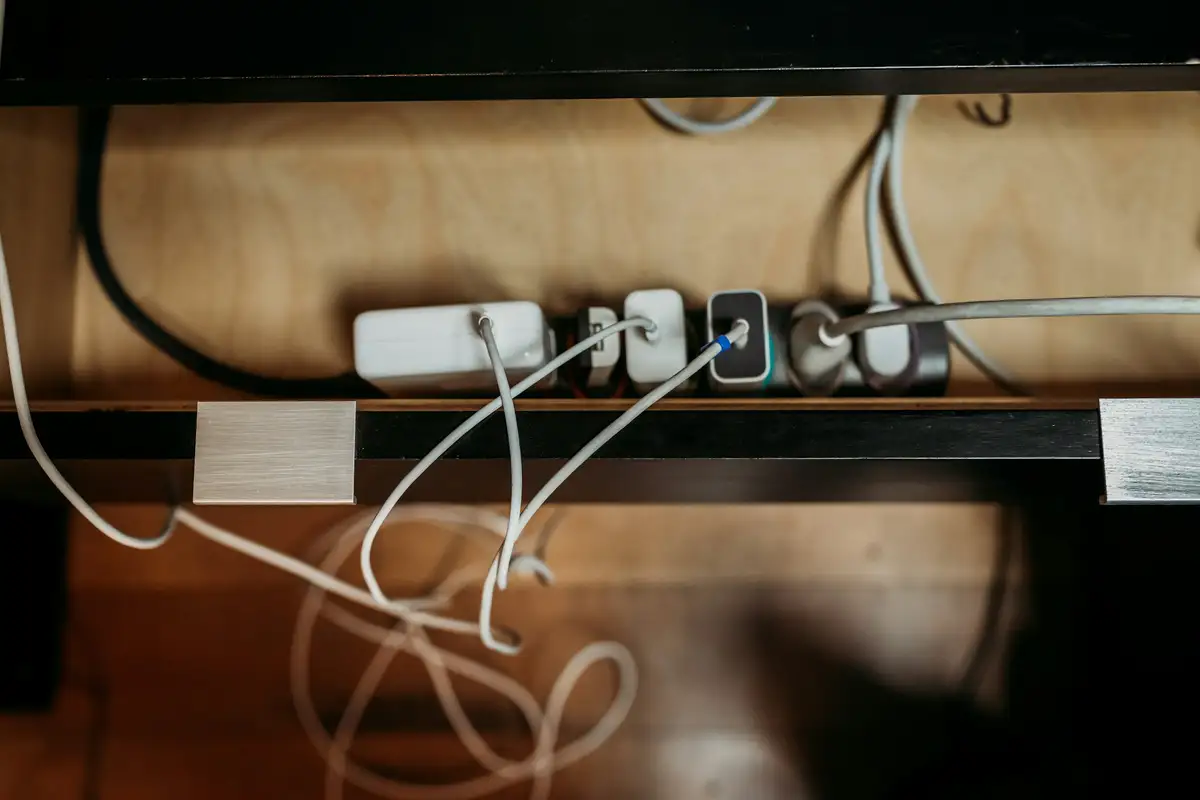
A storm killed my power strip in May, and everything plugged in behind it survived. Two months to understand what that doesn't prove.

What the thief left in my bag
Nine objects ignored in four seconds. A stranger's ranking of my own belongings looks nothing like the one I'd have made myself.